Institutional executive brief
Why a photograph can lose its connection to the person who made it, how IPFN helps, and what we propose testing with European institutions.
IPFN public beta. Learn more →
The institutional proposal
IPFN is like an ISBN for images. It gives a work a registered number that works as a web address. Open it to find the artist named in the registration and the evidence attached to the work.
The International Pinned File Number is a web-native identifier for creative work. You can share its link with an image or put its QR code on a gallery label, giving someone who encounters the work a place to start. Copyright does not depend on registering with IPFN; registration documents a claim rather than deciding who owns it.
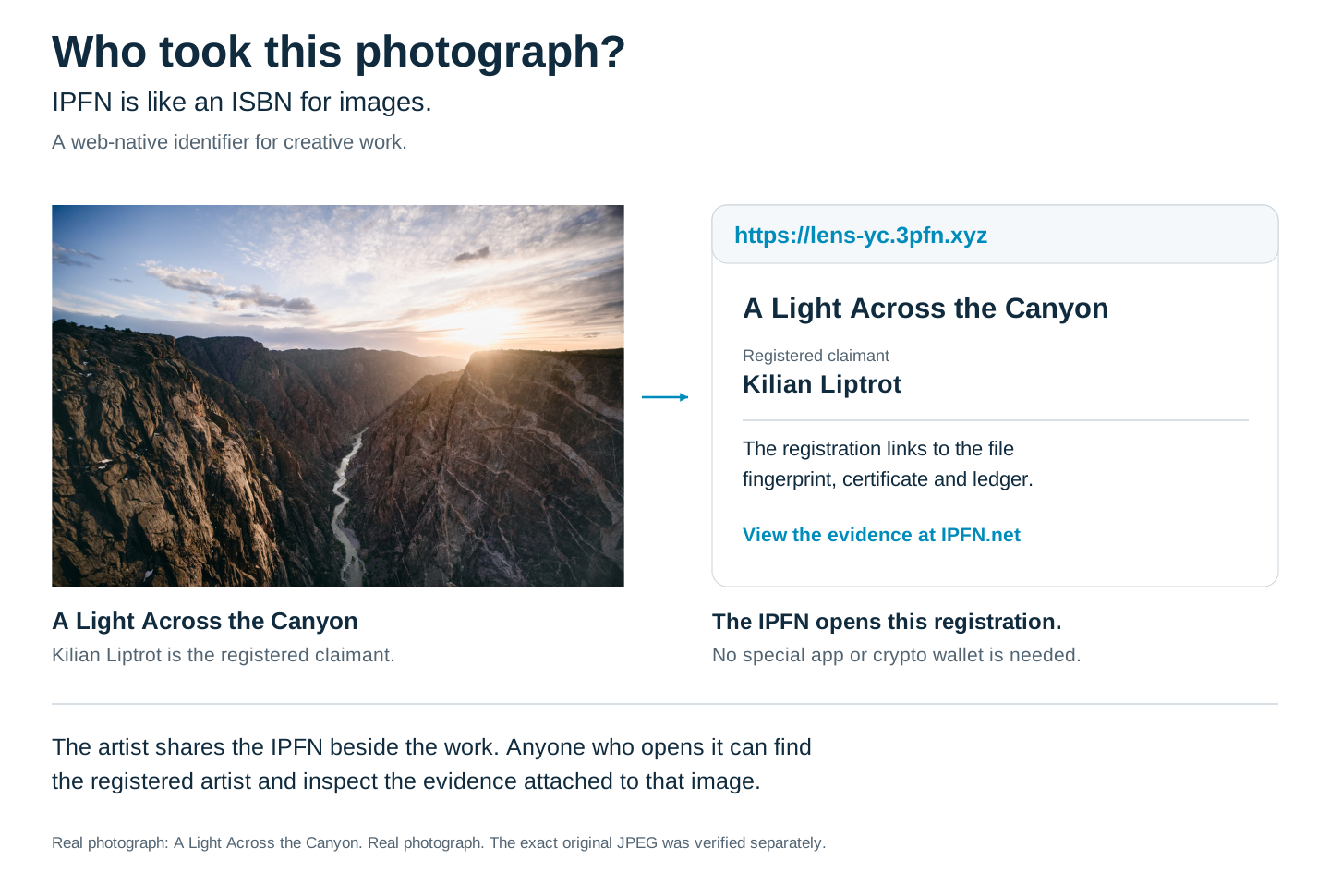
At Blinding Visuals Press, we ran into a practical publishing problem. We needed to connect visual work to its artist as it moved through books, exhibitions and commercial use. We also needed someone outside our business to be able to check the registration and its evidence.
We developed the IPFN file chain to solve that problem. Then we realized the same technology could serve a much wider creative community. The papers below explain what works today and how we propose testing it with the people who could put it to public use.
The revised technical paper and photographic evidence edition are version 2.0. Start with the executive brief. The other papers explain the technology, reproduce the evidence, and set out the proposed institutional responsibilities. The governance, pilot and consultation papers retain their first-edition text. Each PDF can be opened or downloaded separately. This edition is dated .
Why a photograph can lose its connection to the person who made it, how IPFN helps, and what we propose testing with European institutions.
Follow a work through registration, its exact-file fingerprint, its IPFS certificate and the daily ledger anchored on Base, an Ethereum layer 2.
Reproduce the checks for A Light Across the Canyon: compare the certificate, ledger and blockchain transaction using the published bytes and instructions.
To run the checks yourself, download the evidence files and verification script (ZIP).
The proposed responsibilities for running the service, protecting personal information, correcting mistakes, resolving disputed claims and exporting records.
A funded test with ten works, designed to measure whether artists and the people encountering their work can use the service without paying for a basic record.
A proposed contribution to the European copyright and AI conversation, connecting the practical attribution problem to a voluntary pilot and existing institutions.
The illustrated file chain and an explanation of why its different parts let another person check the evidence.
A proposed European pilot
We want to test whether an artist can register a work and whether someone encountering it can find the named artist, check the evidence, and understand how to correct or challenge the claim. A museum, municipal collection or artist-led archive could help evaluate that experience with its own works and audiences.
The proposed first phase would run for 90 days with ten works, after participants, funding and data-protection responsibilities are agreed. It would include independent evidence checks, an export of the records and a correction or disputed-claim exercise. The outcome should be a clear account of what helped artists and visitors, what failed, and what an institution would need before using it more widely.
The proposal is for a funded basic service that is free for creators. That is a proposed public-interest model, separate from the current paid beta registration service. It is not an announced EU partnership or a change to copyright registration requirements.
A file fingerprint can check whether a file matches the registered bytes. With Blinding Visuals Press, IPFN is also developing AI-assisted image-similarity research to help find possible copying. That work is under development; the current service does not offer a validated plagiarism verdict. A copyright dispute still requires the facts and the appropriate legal process.
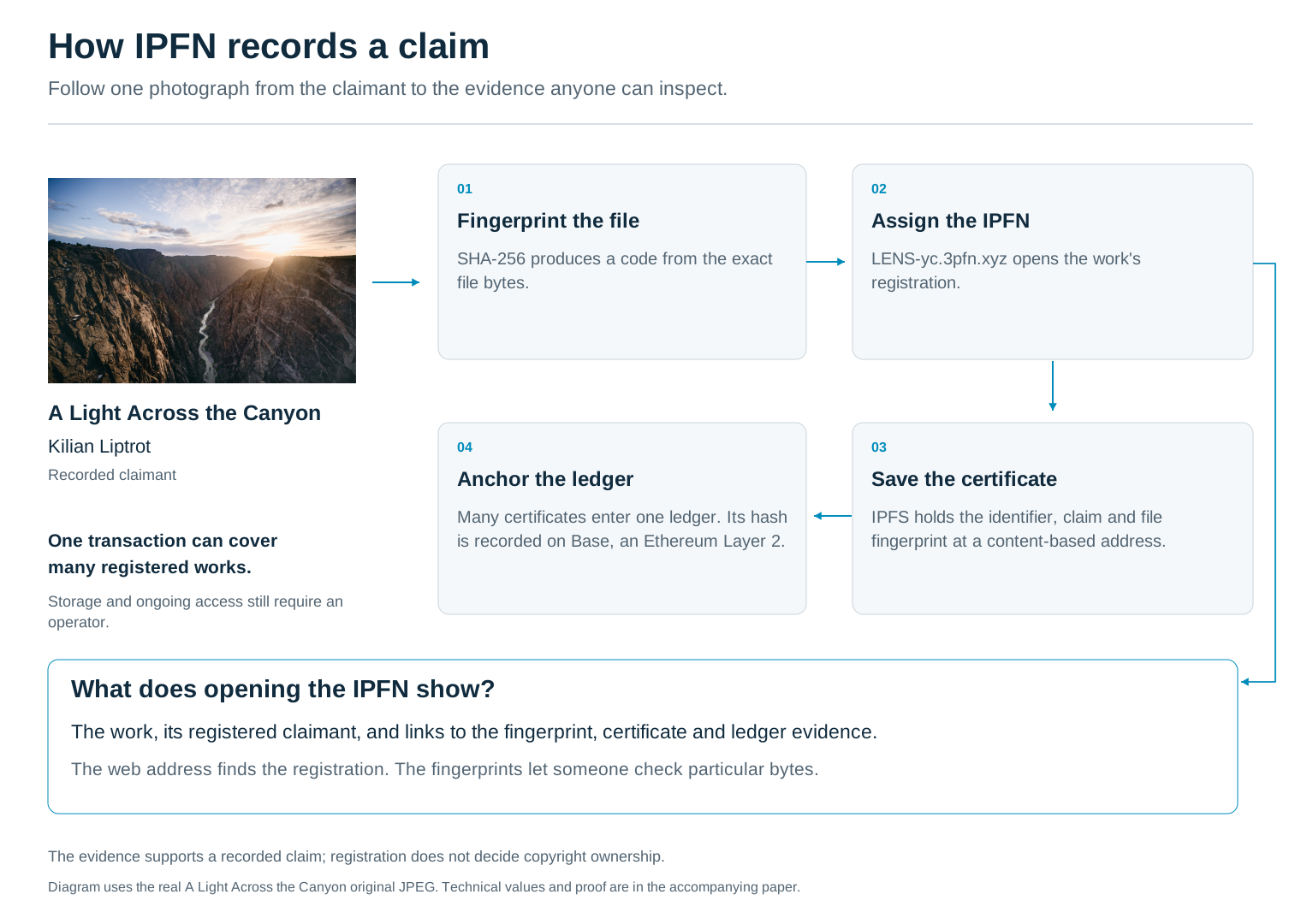
The technical white paper explains what passes between these stages and how to check the completed steps. The number helps you find the registration; the evidence supports the checks.
Open the full-size file-chain diagram